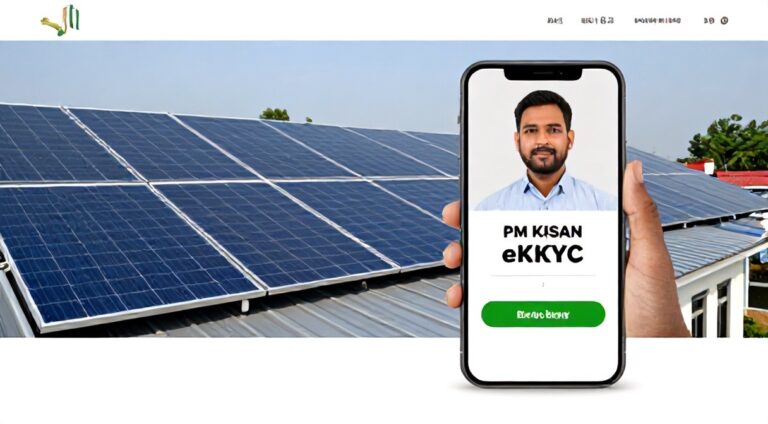

The PM Surya Ghar Muft Bijli Yojana is a flagship rooftop solar initiative launched by the Government of India in February 2024 to encourage clean energy adoption and substantially lower household electricity expenditures. Aiming to provide up to 300 units of free electricity every month to one crore households across the country, the scheme offers direct financial subsidies, concessional bank financing, and a streamlined digital application pipeline. By incentivizing homeowners to install grid-connected solar panels, the initiative blends personal utility savings with broader national renewable energy targets.
What is the PM Surya Ghar Muft Bijli Yojana?
Announced with an approved central financial outlay of ₹75,021 crore, the scheme restructures and significantly expands the earlier National Rooftop Solar Programme. Under the earlier framework, consumer subsidies were lower and approvals frequently encountered procedural friction across varied state distribution companies (DISCOMs).
Under the revised scheme, central financial assistance (CFA) is disbursed directly to beneficiary bank accounts via Direct Benefit Transfer (DBT) once an installation is completed and certified. The primary goal is twofold: decentralize domestic power generation so urban and rural households can slash electricity bills, and reduce aggregate demand on conventional coal-fired thermal grids during peak daylight hours.
Detailed Subsidy Structure Under the Scheme
The Ministry of New and Renewable Energy (MNRE) outlines clear subsidy brackets based on the installed capacity of the rooftop solar system. The subsidy is benchmarked against the standard electricity requirements of an average residential household:
- Systems up to 2 kW capacity: A central subsidy of ₹30,000 per kW is provided. Consequently, a 1 kW rooftop setup receives ₹30,000, while a 2 kW setup receives a total of ₹60,000.
- Systems above 2 kW and up to 3 kW capacity: For capacity added beyond 2 kW up to 3 kW, an additional financial aid of ₹18,000 per kW is granted. Therefore, a complete 3 kW residential system receives the maximum standard residential subsidy of ₹78,000 (₹60,000 for the initial 2 kW + ₹18,000 for the third kW).
- Systems above 3 kW capacity: For systems larger than 3 kW installed on individual residential homes, the central subsidy is capped at ₹78,000. Homeowners may install larger systems (e.g., 5 kW or 10 kW) subject to roof space and DISCOM technical sanctions, but the central financial incentive does not exceed the ₹78,000 ceiling.
- Group Housing Societies and Residential Welfare Associations (GHS/RWA): Residential societies installing shared rooftop systems for common facilities (such as lifts, community lighting, and water pumping) or common electric vehicle charging points can receive a subsidy of ₹18,000 per kW, up to an aggregate cap of 500 kW capacity.
It is important to note that capital costs of solar panels, inverters, and mounting structures vary depending on component efficiency (e.g., mono PERC vs. polycrystalline modules) and regional vendor rates. Consumers must pay the balance amount to the registered vendor after the subsidy is accounted for.
Who is Eligible to Apply?
To qualify for the subsidy under the PM Surya Ghar Muft Bijli Yojana, an applicant must satisfy the following baseline eligibility conditions:
- Indian Citizenship: The primary applicant must be a citizen of India.
- Property Ownership: The applicant must own a residential house with an unshaded, structurally stable roof suitable for solar panel erection.
- Valid Electricity Connection: The property must have an active metered domestic electricity connection in the applicant’s or a resident family member’s name with the local DISCOM.
- Absence of Duplicate Subsidies: The applicant must not have already claimed another central government subsidy for a rooftop solar system on the exact same connection or premise.
- Approved Components: To be eligible for MNRE subsidies, solar modules and inverters must comply with Domestic Content Requirement (DCR) norms, utilizing solar cells and modules certified under the ALMM (Approved List of Models and Manufacturers).
Key Documents Needed for the Application
Keep digital copies (PDF or JPG format) of the following records ready before beginning the registration:
- Recent domestic electricity bill (showing the consumer account number, connected load, and address).
- Identity proof (such as Aadhaar card or PAN card).
- Proof of address (Aadhaar, utility bill, or voter ID matching the property).
- Proof of roof ownership or property title document.
- Bank account details (cancelled cheque or first page of bank passbook) showing account number and IFSC code for direct subsidy credit.
- A clear photograph of the rooftop space.
Step-by-Step Online Application Process
The entire onboarding and disbursement pipeline is managed through the unified national portal. Follow this step-by-step workflow to complete the submission:
Step 1: Portal Registration
Visit the official portal at pmsuryaghar.gov.in. Click on the registration link and select your state, Union Territory, and local electricity distribution company (DISCOM). Enter your consumer account number precisely as printed on your recent electricity bill, followed by your mobile number and email address to complete verification.
Step 2: Submitting the Application for Feasibility
Log in using your registered mobile number. Fill out the online rooftop solar application form, specifying your proposed plant capacity (in kW) and rooftop area. Once submitted, the application flows to your local DISCOM for technical feasibility assessment. The DISCOM evaluates whether your local distribution transformer capacity can support the additional power injection.
Step 3: Vendor Selection and Installation
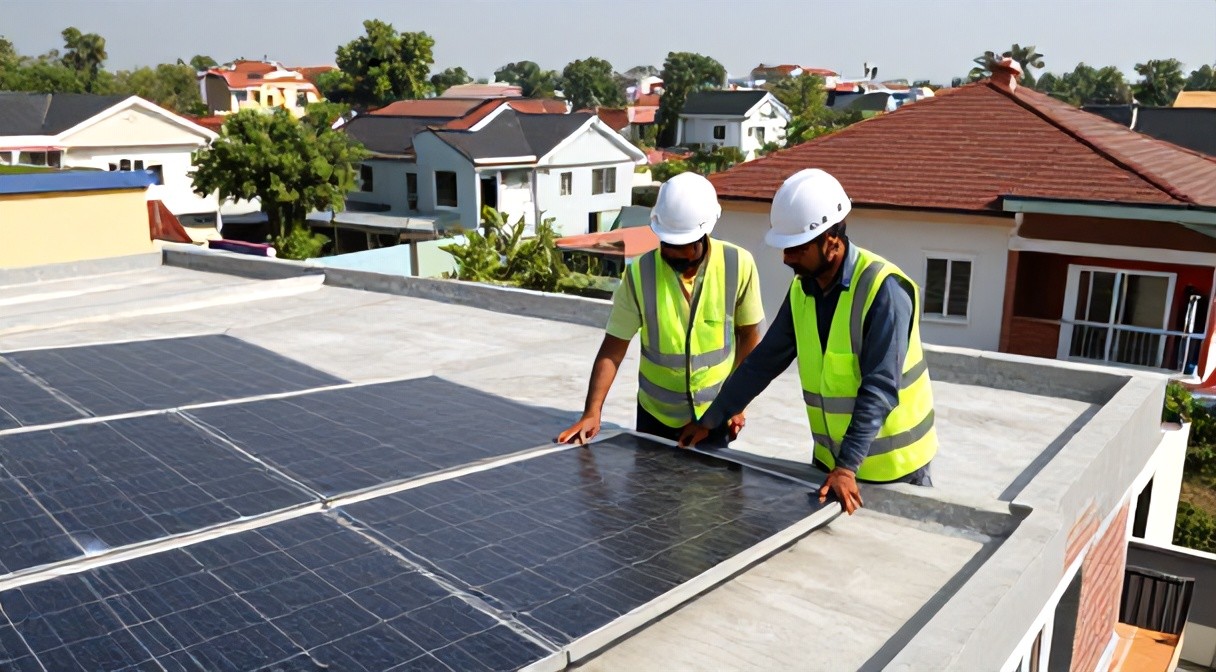
Once you receive technical feasibility approval from the DISCOM, choose an MNRE-registered or DISCOM-empanelled vendor. Work with the vendor to finalize the plant design, component specifications (DCR-compliant panels and inverters), and contract terms. The vendor will execute the physical installation on your rooftop.
Step 4: Net Meter Installation and Inspection
Following installation, the vendor or consumer submits the installation details and work completion report on the portal. The DISCOM conducts a physical site inspection to verify compliance with technical standards. Upon successful inspection, the DISCOM installs and seals a bidirectional “net meter” that records both imported grid energy and exported solar energy.
Step 5: Commissioning Certificate and Subsidy Credit
Once the net meter is integrated, the DISCOM issues an online commissioning certificate on the portal. Log back into your portal profile, submit your bank details alongside a digital copy of a cancelled cheque, and submit the subsidy claim. The central subsidy is transferred directly to your bank account via DBT, typically within 30 days of final document verification.
Financing and Low-Interest Bank Loans
For households that prefer not to pay the full upfront installation cost from out-of-pocket savings, the government has partnered with major scheduled commercial banks and public sector lenders. Under this framework, collateral-free loans are offered at concessional interest rates (benchmarked around the prevailing repo rate plus a modest spread, typically around 7% per annum) for residential rooftop installations up to 3 kW. Repayment tenures generally extend up to 7 to 10 years, allowing the monthly electricity savings to offset loan installments.
Practical Considerations, Limitations, and Grid Dynamics
While the PM Surya Ghar Muft Bijli Yojana presents clear economic advantages, prospective beneficiaries should assess several practical constraints:
- Shading and Orientation: Solar panels require adequate direct sunlight. Roofs obstructed by taller surrounding buildings, dense tree cover, or complex architectural projections will experience reduced generation yields.
- Roof Integrity: Rooftops must support mounting structures designed to withstand high wind velocities. Weak asbestos sheets or aging civil structures may require costly structural reinforcement.
- Grid-Tied Dependency: The standard subsidized system is grid-tied without battery storage. Under standard safety regulations, grid-tied inverters automatically shut down during local power outages (islanding protection) to prevent electrocuting utility maintenance personnel. Consumers seeking backup during blackouts must procure separate hybrid inverters and battery banks, which are not covered under the central subsidy.
- DISCOM Processing Timelines: While the national portal standardizes applications, technical feasibility approvals and net-meter procurement times vary across jurisdictions depending on local DISCOM operational capacity.
Frequently Asked Questions (FAQs)
Can tenants living in rented accommodation apply?
No. The subsidy requires roof ownership and structural consent from the property owner. Tenants cannot claim subsidies on properties they do not own unless the property owner applies directly on their own meter.
How long does it take to receive the subsidy in the bank account?
Once the DISCOM uploads the commissioning certificate and the applicant submits valid bank credentials, the DBT subsidy is typically processed and credited within 30 days, subject to proper bank account and Aadhaar linkage.
Is net metering mandatory to receive the subsidy?
Yes. The scheme exclusively covers grid-connected rooftop solar installations that feed excess generation back into the local utility network through an authorized bidirectional net meter.
Are commercial properties or offices eligible under this scheme?
No. The PM Surya Ghar Muft Bijli Yojana is strictly reserved for individual residential households, residential welfare associations, and group housing societies. Commercial, industrial, and institutional consumers are ineligible for this specific subsidy.